Lockheed Martin
The Lockheed Martin F-35 Lightning II is an American family of single-seat, single-engine, supersonic stealth strike fighters. A multirole combat aircraft designed for air superiority and strike missions, it also has electronic warfare and intelligence, surveillance, and reconnaissance capabilities. Lockheed Martin is the prime contractor, with partners Northrop Grumman and BAE Systems. The aircraft has three main variants: the conventional takeoff and landing F-35A, the short take-off and vertical-landing F-35B, and the carrier variant catapult-assisted take-off but arrested recovery F-35C. With 883 aircraft in service as of 2025, it is the world’s fourth-most-numerous military aircraft, and most-numerous stealth aircraft.[5]
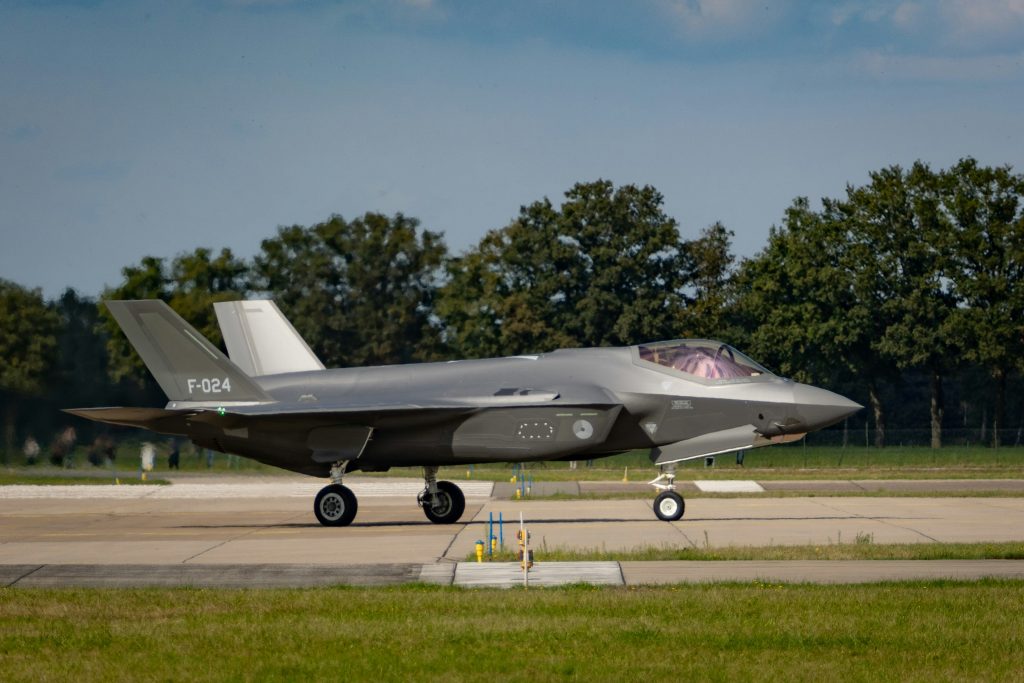
The aircraft descends from the Lockheed Martin X-35, which in 2001 beat the Boeing X-32 to win the Joint Strike Fighter program, to replace the F-16 Fighting Falcon, F/A-18 Hornet, and the McDonnell Douglas AV-8B Harrier II, and others. Development was primarily funded by the United States, with additional funding from select NATO members and Australia; Turkey was removed from the program in 2019.[6][7][8] As of April 2026, the US operates all three main variants; both F-35A and F-35B variants are operated by Italy and Japan; F-35As are operated by Australia, Belgium, Denmark, Netherlands, Norway, Poland, and South Korea; the F-35B is operated by the United Kingdom. Israel operates its own F-35I variant. Six further NATO members, as well as Switzerland and Singapore have also placed orders, and other countries are considering purchases.
The program has drawn criticism for its unprecedented size, complexity, ballooning costs, and delayed deliveries,[9][N 1] partially caused by low rate initial production during its development.[11][12] As of 2024, the program is expected to cost some US$2 trillion through 2088.[13] As of 2024, the average flyaway cost excluding the engine is: F-35A, $82.5 million; F-35B, $109 million; and F-35C, $102.1 million.[14] An F135 engine costs $20.4 million as of 2025.[15]
The F-35 first flew in 2006; its variants entered U.S. service in 2015 (Marine Corps F-35B), 2016 (Air Force F-35A), and 2019 (Navy F-35C).[2][3][4] The F-35 first saw combat in the 2018 Israeli strikes in Syria,[16] the F-35B in 2018 by US strikes in Afghanistan, and the F-35C in 2024 in US strikes in Yemen. F-35s have since been used in combat by the U.S. in Iraq, Iran (2025 and 2026), and Venezuela; by Israel in Gaza, Iraq, Iran (2025 and 2026), Lebanon, and Yemen; and by the UK in Iraq and Syria. F-35As can deliver two U.S. B61 nuclear bombs,[N 2] including those deployed in the Netherlands and the United Kingdom. Belgium, Germany, Italy, and the UK plan to buy nuclear-capable F-35As; Israel’s F-35Is may be able to deliver Israeli nuclear weapons. The U.S. plans to buy 2,456 F-35s through 2044, which will represent the bulk of its crewed fixed-wing tactical aviation for several decades; the aircraft is to be a cornerstone of NATO and U.S.-allied air power and operate until 2088.[18][19][20][13]